Class 10 Physics: Light, Reflection and Refraction
Ray diagrams are reasoning tools: they show the path a narrow beam could take and make image position, size and orientation easier to discuss.
What to understand
- Describe the central idea in your own words.
- Use a model, observation or relationship to explain a changed example.
- Notice and correct the likely misconception in the worked reasoning.
Construct the path
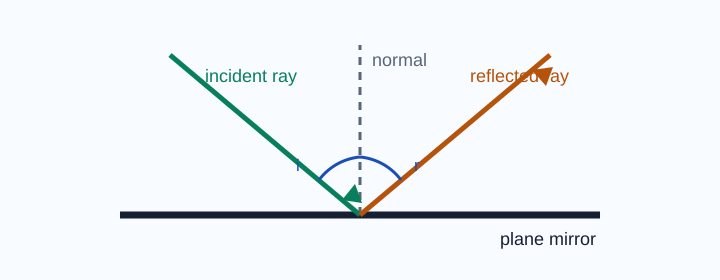
The angle of incidence is measured from the normal, not from the surface. In reflection, the angle of incidence equals the angle of reflection. Refraction occurs because light changes speed when it enters a different medium, causing the path to bend unless it enters along the normal.
A converging lens can form real or virtual images depending on object position. Always label the principal axis, optical centre or focus used in your construction rather than drawing an unexplained arrow.
Try, explain and check
Construct two reflected rays and locate the image behind a plane mirror.
Show a reasoning prompt
Why does a pencil look displaced in a glass of water?
Show a reasoning prompt
Measure angles from the normal in every ray diagram.
Show a reasoning prompt
Next step
Write a three-sentence revision summary, then continue to the related resource. For extra practice, visit the resource library and choose a worksheet that matches the skill you need.